The Curtain Comes Down Fast: A Driver's Pre-Flight Check for Lake-Effect Snow Bands
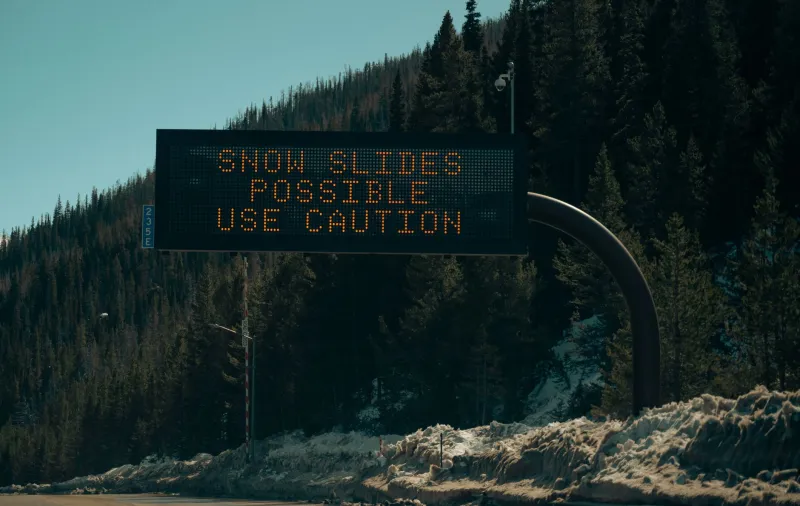
Every November, somewhere around the Great Lakes, a driver looks at a gray smear on the horizon, decides it is probably fine, and merges into a stretch of interstate where the lane lines disappear. The warning language we use for that moment — visibility dropping fast — is not a warning at all. It is a description of something that is already happening to you.
What drivers need instead is a number, a short sequence, and one clear place to stop. So treat this as a preseason drill. Before the first lake-effect band of the 2026–27 winter settles over I-90 outside Buffalo, I-196 in Michigan, I-80 across Pennsylvania, or the Indiana Toll Road, run a ten-second check. Five glances, two seconds each, and a binary outcome: pull over or proceed.
Why 'visibility dropping fast' fails as a warning
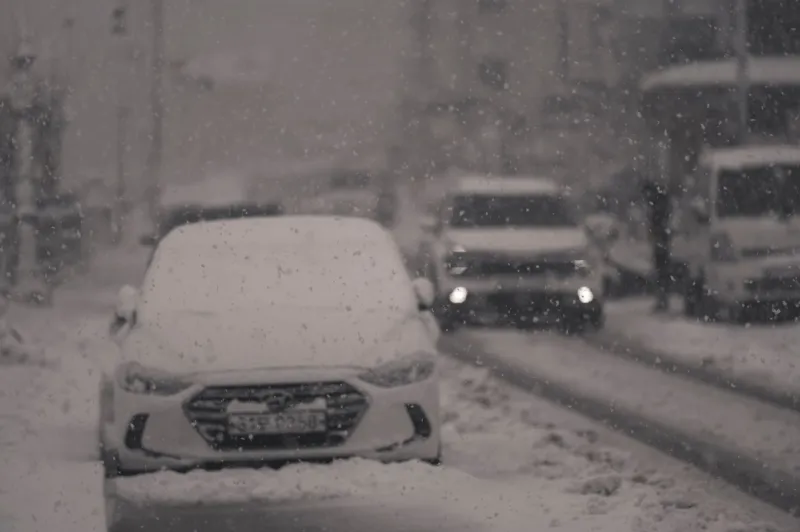
Reconstruction reports from state police and DOT incident logs read like timestamps. A band edge crosses the highway. Within a few minutes, traffic compresses. Within a few more, the first chain-reaction collision blocks a lane, and the backup becomes its own hazard as more cars arrive at speed with nowhere to go. The dangerous interval is not the middle of the storm. It is the entrance to it.
The physics is unforgiving. At 65 mph you cover about 95 feet per second. Even on dry asphalt, stopping eats up roughly the length of a football field plus the time your brain needs to believe what the windshield is showing. Add slush and that number balloons. A driver who enters a whiteout at highway speed has already spent the only decision they were going to get.
Human factors make it worse. A wall of snow ahead reads as a maybe — maybe it thins out, maybe it is just the edge of the band, maybe the plow came through five minutes ago. That ambiguity is exactly what a ten-second check is built to kill.
How a lake-effect band builds a wall in under a mile
Cold air crossing a relatively warm lake picks up heat and moisture, grows unstable, and dumps it downwind in narrow, wind-aligned bands. In November and December, the lakes still hold summer's stored heat, which is why the first bands of the year so often catch people out. Rates of one to three inches an hour are routine inside a band, and thundersnow is not rare.
The geography is what makes it a highway problem. Bands can run five to thirty miles wide with a hard edge on the upwind side, and they drift. A route that is dry at 7:00 a.m. can be a different road by 7:40. In the well-known corridors — the Tug Hill Plateau, the Chautauqua Ridge, the snowbelt east of Cleveland, the lakeshore stretch of I-196 — that drift is measured in miles, not counties. Which is why a forecast for your ZIP code can be technically correct and completely useless.
The ten-second check: five glances, two seconds each
Run this in the on-ramp, the park-and-ride, or at the last traffic light before the highway. Not while merging.
- The edge (2 seconds). Can you see the far side of the band, or only the near wall? A visible boundary means you can see through it. A flat gray curtain with no horizon means you cannot.
- The stack (2 seconds). Look a quarter mile ahead for brake lights. If traffic is already bunching before you reach the snow, the crash risk is upstream of you.
- The exit (2 seconds). Name the next exit, rest area, or interchange out loud. If you cannot name one within a mile, you have no pull-over option, and the road has made the decision for you.
- The rig (2 seconds). Low beams, not high beams — high beams bounce off snow and blind you. Defrost on, wipers on, washer reservoir topped with winter mix, headlights on even in daylight.
- The plan (2 seconds). Pull up the state 511 app or a DOT camera for the corridor ahead, and make sure someone knows your route and rough ETA. Ten seconds of phone use here is worth an hour of guessing later.
The pull-over-or-proceed framework
Proceed if:
- You can see the far edge of the band and it is less than a mile out.
- An exit or interchange sits within a mile of your position.
- Traffic ahead is spaced out and visible, not a knot of red lights.
- You are rested, fueled, and comfortable with the light conditions.
- Roads are already snow-packed and treated rather than wet and refreezing.
Pull over if:
- The far side of the band is invisible.
- Traffic is compressing ahead of you.
- You are approaching a bridge, an overpass, or open farmland where wind-driven snow strips visibility to nothing.
- The temperature is hovering between 25°F and 34°F after rain or a thaw. That is flash-freeze territory, and the pavement is about to become glass.
- You are tired, or you have already driven through one band and your shoulders are up around your ears.
Proceeding is not a commitment to the whole trip. The framework is meant to be re-run at every band edge, which on a rough day can mean four or five times between exits.
If you stop, stop correctly
- Take the exit if there is one. A truck stop lot beats a shoulder every time.
- If you must stop on the shoulder, get as far right as the pavement and guardrail allow, switch on hazards, and keep your seatbelt fastened.
- Stay in the vehicle. Do not stand behind the bumper, do not walk out to look, do not try to wave traffic around.
- Keep the tailpipe clear of snow and avoid long idling sessions with the windows sealed. Carbon monoxide kills people in parked cars every winter.
- If traffic ahead has already crashed and you are stopped in a lane, leave space, keep hazards on, and stay put.
Tape this to the dashboard
BAND AHEAD? FIVE GLANCES, TWO SECONDS EACH
1 EDGE  — can I see through it?
2 STACK — brake lights bunching?
3 EXIT  — name one within a mile
4 RIG   — low beams, defrost, washer
5 PLAN  — 511 check, someone knows my route

NO FAR EDGE + NO EXIT = PULL OVER
Shoulder stop: hazards on, stay belted, tailpipe clear
The first band of the season does not care whether you have driven in snow for thirty years. It only cares whether you were at highway speed when it arrived. Ten seconds at the on-ramp is a lot cheaper than the alternative.