Sixty Seconds in the Ditch: Drilling the Whiteout Exit Before You Need It
The scenarios that go wrong in a whiteout rarely go wrong because the driver lacked a folding shovel. They go wrong because nobody had decided in advance what the first sixty seconds would look like. Decisions made in a cold car with the engine off and traffic hissing past in the gray are expensive decisions. Rehearsed ones are cheap.
So treat the following as a script, not a lecture. Read it once. Run it at home in ten minutes. Then run it again in January, in the driveway, in your actual coat and actual boots.
Why the First Minute Sets Everything Else
The first sixty seconds after you leave the road determine almost everything that follows: whether you end up standing outside the car where you can't be seen, whether the tailpipe is buried, whether anyone knows where you are, and whether you spend the next four hours calm or panicking. Get the order right and the rest of the event becomes boring. Boring is the goal.
The Household Rehearsal (Ten Minutes, Indoors)
Before the drill, do the boring prep that makes the drill possible.
- One physical card in the glovebox. Not an app. A card with your emergency contacts, your insurance and roadside number, your plate number, and the phrase "call 911, give mile marker." Screens die in the cold.
- A check-in person. Someone who knows your route and your arrival window and who will act if you don't call. For solo travelers crossing the Plains or the Rockies, that person plus a satellite messenger is the whole safety net.
- Layers in the cabin, not the trunk. Anything you'd need in the first hour—blanket, hats, gloves, hand warmers—rides where you can reach it buckled in.
- A bright cloth and a headlamp. Visibility is the entire survival problem. Signal first, comfort second.
Now assign roles out loud. Who calls? Who gets the reflector or the bright cloth out? Who keeps the kids calm and counting? Kids who have a job don't spiral. Adults who have a job don't either.
Seconds 0–15: Stop the Slide
Both hands on the wheel. Look where you want to go, not at what you're about to hit. Steer gently—no sharp corrections, no stabbing the brakes. If the car is sliding, you want a light, smooth input that lets the tires find grip.
Once you're stopped, resist the urge to fix things by driving. Spinning your wheels digs you deeper and can walk you toward a ditch that's steeper than the one you're in. If you're off the pavement and the car is stable, leave it.
Hazards on immediately. All four. Not just because someone might see you, but because a white car sitting at an angle in a whiteout is genuinely invisible.
Seconds 15–30: The Stay-or-Go Call
In almost every whiteout stranding, the answer is stay. The vehicle is shelter, it's visible, it's locatable, and it holds your supplies. Walking out means leaving all three behind in conditions where you can lose the car—and the road—within twenty paces.
The exception is narrow and specific: you can plainly see a building, a lit open business, or a house, at a distance you could cover in a couple of minutes while staying out of the travel lane entirely. If that's the case, take your phone, your keys, and your outer layer, and go. If you're not certain, you stay. Certainty is the test.
Seconds 30–45: Make the Call That Finds You
Dial 911 if you're on a highway, in a travel lane, or hurt. Give four things in this order: the road and direction, the nearest mile marker or exit, what happened, and how many people are with you. Mile markers exist to be read. If you don't know yours, use your phone's location sharing and read the coordinates aloud.
Can't get a signal? Send a text—they often squeeze through when a call won't—and then start a check-in rhythm: one text every fifteen minutes to your person, battery permitting. Turn on airplane mode or low-power mode between attempts so you're not burning the battery hunting for a tower that isn't there.
Seconds 45–60: The Tailpipe Check
This is the step people skip, and it's the one that kills. Before you run the engine for heat, get out—safely, on the side away from traffic—and confirm the exhaust pipe is clear of snow. A buried or drifted tailpipe pushes carbon monoxide back into the cabin.
Carbon monoxide is odorless and its early symptoms, headache and drowsiness and nausea, read exactly like being tired and cold. The CDC's guidance for stranded drivers is to run the engine only long enough to warm up, crack a window, and never idle with the tailpipe blocked. Keep a window down a finger's width even when it's brutal outside. That draft is cheaper than the alternative.
If you can't verify the pipe is clear, don't run the engine. Layers and movement instead.
The Long Wait: Warmth Without a Running Engine
Get your layers on before you're cold. Eat something; digestion matters more than it sounds. Move every twenty to thirty minutes—flex your hands and feet, shift positions, do small isometrics—because moving muscles make heat and staying still lets it drain. Huddle together rather than spreading out across the seats.
Run the engine in short bursts. Ten or fifteen minutes of heat, then off. Between bursts, wrap up and let the cabin cool slowly. And keep one person awake and watching the mirrors.
Being Found: Visibility Discipline
Signaling is a system, not a single act. Hazards stay on. Hang your bright cloth from the driver's window or antenna. At night, a headlamp pointed at the ceiling of the cabin makes the whole car glow rather than blinding anyone. Don't burn your battery on the dome light for hours—conserve it for the moments when headlights in the mirror tell you someone's actually close.
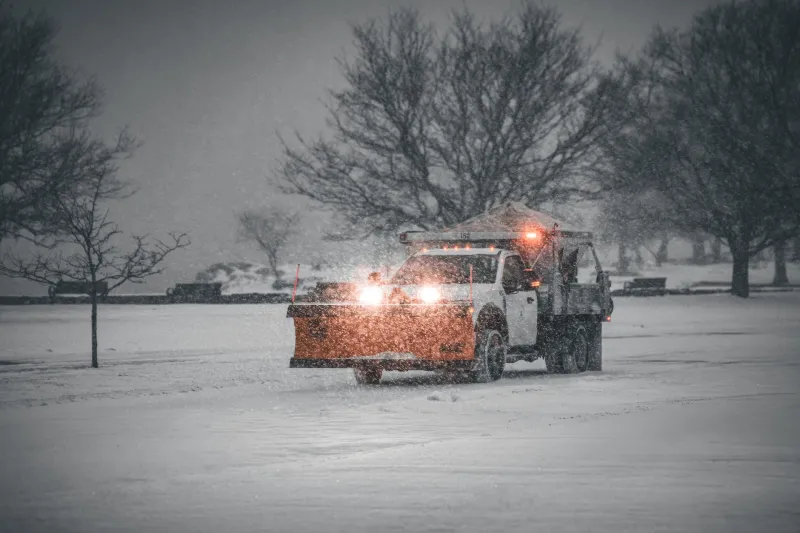
When you do see a plow or trooper, resist the urge to sprint toward the road. Let them come to you.
Run It Again in January
A drill that lives only on paper is trivia. Practice the sequence at home, then practice the physical parts in the driveway on a cold evening: hood up, find the tailpipe, clear it with a scraper, get back in, start the engine, crack the window. Time it. Ninety seconds is fine.
Do it once with the kids in the back seat narrating their jobs. Do it once solo, in the dark, with gloves on, because that's how it will happen. The night you actually need it, you won't be learning anything new. You'll just be repeating something you already know.