Three Red Flags on the Ridge: When to Bail Before the Mountain Goes Blank
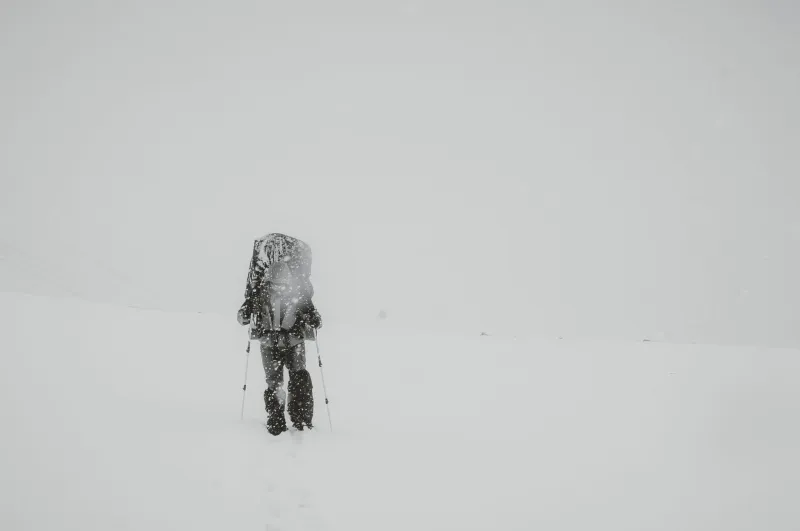
Whiteouts rarely arrive like a curtain dropping on cue. In the mountains, they often build: a little wind, a little snow, a horizon that gets softer, then a ridge that vanishes. By the time your brain labels it a whiteout, you may already be deeper in than you planned. That is why backcountry travelers need a decision framework they can use before visibility goes to zero, not after.
The whiteout triangle is a simple one: three signals—shrinking visibility, wind-loaded terrain, and a falling temperature trend. Treat each as a red flag. One flag means pay attention. Two means start your exit. Three means you should already be heading down or hunkering in a safe spot. The exact thresholds are yours to set at the trailhead, when you are warm, calm, and not trying to salvage a summit.
Why the Mountain Goes Blank
A whiteout is not just heavy snow. It is a loss of contrast. Falling snow, blowing snow, fog, and flat light can merge ground and sky into one gray surface. In the Cascades, the Rockies, the White Mountains of New Hampshire, and the Sierra, this can happen fast when wind picks up snow that already fell and moves it across open terrain. You do not need a named storm for visibility to collapse. You need wind, snow available for transport, and a route that exposes you to both.
The tricky part is that whiteouts degrade judgment before they degrade vision. Your inner ear and eyes disagree. A slope that looked gentle at the trailhead feels steeper. A familiar ridge line looks wrong. This is why the decision has to be made early, using signals you can count, not a gut feeling you have to trust in the worst possible conditions.
Signal One: Visibility That Shrinks Between Steps
Pick three reference points at the start of your day: a tree line, a rock outcrop, a saddle, a building, a ridge. Note how long it normally takes to see the next one. If those landmarks start disappearing sooner than expected, or if shadows vanish entirely, you have your first flag.
For hikers and snowshoers, a useful threshold is the next cairn or blaze. If you cannot see the next marker from the current one, visibility is already poor enough to slow down and reassess. For ski tourers, watch the horizon and the texture of the snow surface. When the snow ahead stops showing texture and the sky stops showing a horizon, you are losing depth cues. GPS is helpful, but it is not a substitute for seeing the terrain. A screen can tell you where you are; it cannot tell you whether the slope above you is loaded and ready to move.
Signal Two: Wind-Loaded Terrain
Wind-loaded terrain is the second flag, and it is the one people most often talk themselves out of. Wind moves snow onto lee slopes, behind ridges, and under cornices. The result can be a wind slab—a stiff, cohesive layer that can crack and slide. Clues include smooth, pillowy snow, freshly formed cornices, shooting cracks, and the hollow whumpf sound that makes every backcountry traveler stop and listen.
You do not need to be a forecaster to treat this as a warning. If the terrain around you looks wind-loaded and visibility is dropping, the combination is dangerous. Snowshoers can trigger slabs too. Ski tourers may be focused on the up track and miss that the slope beside them has changed. If you hear a whumpf or see a crack, that is not a signal to keep moving. It is a signal to avoid the slope, choose a lower-angle route, and check the local avalanche forecast before committing to anything bigger.
Signal Three: The Temperature Trend That Won't Quit
A dropping temperature trend is the third flag. It matters because cold air changes the snow surface, increases wind chill, and makes wet clothing a bigger problem. Watch for wet snow turning dry and squeaky, trees shedding their load, your breath hanging longer, or your gloves getting stiff. A thermometer is useful, but the trend matters more than the number. Ten degrees colder than an hour ago is a message.
When temperature falls while wind rises, hypothermia risk climbs. A whiteout in mild air is disorienting; a whiteout in dropping temperatures is disorienting and physically punishing. Add a tired group and a late start, and the margin for error gets thin fast. That is why the temperature trend belongs in the triangle. It is not just weather trivia. It is a measure of how quickly the day is turning against you.
Build Your Turnaround Rule Before the Trailhead
A turnaround rule is a promise you make before the mountain has a vote. Write it down. Put it in your phone notes. Tell your group. A good rule uses observable triggers, not vague intentions.
For example: turn around if visibility drops below 100 yards, if two of the three whiteout signals appear, if the temperature falls more than 10 degrees from the trailhead reading, or if you are not at the high point by a set time. Choose thresholds that fit your route, your group, and the forecast. Then agree that no one gets to renegotiate just because the summit is close.
This matters most in the 2026–27 winter, when storm tracks can shift and local forecasts can vary sharply across a single range. Check the National Weather Service forecast, the local avalanche center, and the trailhead conditions. But do not outsource the turnaround decision entirely. Forecasts describe possibilities. Your rule handles the moment when the possibility is standing in front of you.
The Triangle in Practice
Imagine a snowshoe route in the Rockies. The forecast mentions increasing wind and snow in the afternoon. At noon, the far ridge disappears. That is one flag. Ten minutes later, you cross a smooth, wind-loaded slope and see a crack near your track. That is two. Your rule says start your exit. You turn around, even though the summit is only 20 minutes away.
Now imagine all three: visibility goes flat, the terrain is wind-loaded, and the temperature is falling. That is not a debate. Get off exposed slopes, move to a safe lower-angle route, and keep the group together. If you cannot navigate safely, stop in a sheltered spot, layer up, and wait for better visibility. Moving blindly in a whiteout is how people walk off a ridge they meant to follow.
The walk out is part of the trip. Carry a headlamp, extra layers, food, water, a compass, and a paper map even if you use GPS. Keep your group close enough to see and hear each other. Leave breadcrumbs in your mind and on your device. The mountain will still be there after the storm. Your job is to make sure you are too.