The Leeward Side of Everything: Scouting Your Block's Drift Map Before the Storm
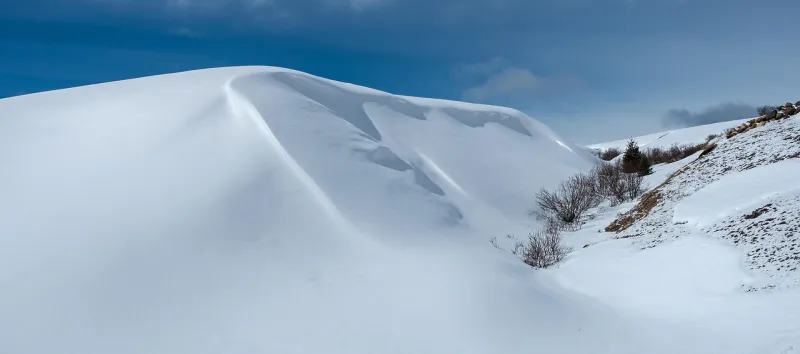
Photo: snowdrift against suburban house fence and garage winter wind pattern, via cdn.pixabay.com
You shovel your walk. Your neighbor shovels theirs. Two hours later, yours is buried again and theirs looks like a putting green. That's not luck, and it's not the plow driver's grudge. It's the wind, and it has been drawing a map of your block since the first cold front of the season.
Snow doesn't fall evenly. It arrives with wind, and wind treats every house, fence, and parked car as furniture in a wind tunnel. The result is a pattern of bare pavement and deep drifts that repeats storm after storm. Learn to read it once, and you'll shovel less, breathe easier, and keep your furnace vent above the snowline.
Wind Doesn't Drop Snow. It Files It.
A snowflake is a tiny particle with almost no mass. Once it's in the air, it goes where the wind pushes it until something gets in the way. When that something is your garage, the airflow splits, curls, and slows. Snow drops out of the slow zone and piles up on the downwind side. Meteorologists call the bare patch on the upwind side a scour zone and the pile behind the obstacle a drift. The calm pocket in between—the place where snow seems to skip your yard entirely—is the snow shadow.
Think of it as the lee side of everything. For a northwest wind, which drives many winter storms across the Midwest and Northeast, the snow shadow sits southeast of the obstacle. For an east wind off the Atlantic, flip it. The shadow moves. The principle doesn't.
Your Block Is a Wind Tunnel With Furniture
Walk your street before the next storm and you'll start seeing the furniture. A detached garage is a blunt wall. Wind hits it, dives over the roof, and eddies behind it. That eddy is where the drift forms—often a crescent-shaped pile a few feet off the back wall, not right against it. A chain-link fence with a gap at the gate acts like a nozzle. Wind accelerates through the gap, shoots snow into a long tongue that can reach halfway across the driveway. A solid fence does the opposite: it creates a calm snow shadow for maybe ten feet downwind, then a drift where the wind reattaches.
Parked cars are smaller but sneakier. A car sitting in the street or at the curb leaves a snow shadow roughly two to three car lengths long on its lee side. That's why one side of the street stays bare and the other gets plowed under. The drift usually builds at the rear quarter of the car, where the airflow wraps around and slows. If your car is parked downwind of a neighbor's fence, expect the tailpipe and tires to be buried first.
House corners matter too. Wind rounding a corner accelerates and curls, carving a bare patch on one side and dumping a pile on the other. Two houses with a narrow gap between them create a venturi—a wind tunnel at sidewalk level—that can strip snow off one lawn and stack it against the next house's foundation. If you've ever wondered why one stretch of sidewalk is always drifted shut, look at the gap upwind of it.
Scout Before the Storm, Not During It
The best time to map your block is 24 to 48 hours before a storm, when the forecast has a wind direction but the ground is still bare. Check the wind forecast—not just speed, but direction. Most US winter storms have a dominant wind, even if it shifts. Then walk the block with your phone and take pictures of the lee sides. Note where the bare patches are after the last storm; they'll be bare again in the same wind.
Mark three things on your mental map: your furnace and water heater exhaust vents, your car's exit path, and the low spots where meltwater pools. Those are the places where a snow shadow can turn into a problem.
The Three Places Snow Shadows Matter Most
First, the vents. High-efficiency furnaces and tankless water heaters often exhaust through PVC pipes near ground level, sometimes on the lee side of the house where drifts build. If that pipe gets buried, the furnace can shut down or, worse, push exhaust back into the house. Carbon monoxide doesn't announce itself. After any drifting storm, walk the perimeter and clear a three-foot radius around every exhaust, intake, and dryer vent. Don't wait for the snow to melt.
Second, the car exit. A drift at the end of the driveway is more than an inconvenience. If your car is parked downwind of the garage or a fence, the tailpipe can be under snow before you start the engine. Never idle in a drift to warm up. Clear the tailpipe first, then the path.
Third, the icy patches. Snow shadows can hide black ice in two ways. A drift that melts at noon and refreezes at five leaves a sheet under a thin crust. And a bare patch downwind of a heat leak—a dryer vent, a foundation—can collect meltwater that refreezes overnight. The lee side of a house is often the last place to get sun and the first place to turn to ice.
Shovel With the Map, Not Against It
Once you know where the drifts form, you can stop fighting them. Shovel before the snow consolidates, and pile snow on the lee side of your property—not on the windward side, where it will just blow back. Clear a path to the vents first, then the car exit, then the walk. If a fence gap is funneling snow into your driveway, a temporary snow fence or a piece of plywood can shift the drift ten feet downwind. It's not pretty, but it beats shoveling the same tongue of snow three times in one night.
And remember that the map changes when the wind shifts. A nor'easter that starts with an east wind will leave different drifts than the northwest wind that follows the cold front. After the storm, take another walk. Note the new piles. Your block is a wind tunnel with furniture, and the furniture doesn't move. The wind does. Learn both, and winter gets a little less random.