The Pavement Is Wearing a Disguise: A Driver’s Guide to Treated Winter Roads
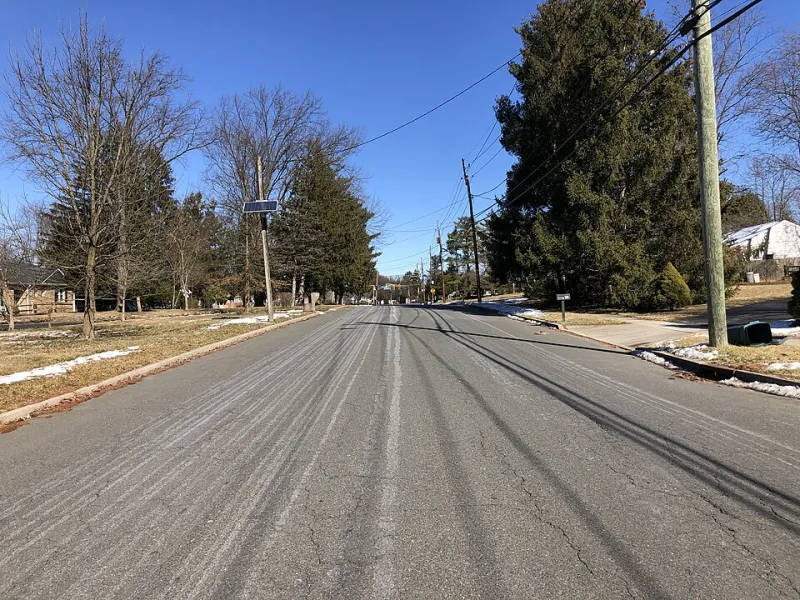
Photo: Famartin, CC BY-SA 4.0, via Wikimedia Commons
You back out of the driveway, and the road looks wet. Dark, shiny, reflective. In July, that’s a simple cue to slow down a little. In winter, it’s a question with several possible answers — and some of them are worse than “wet.”
Pre-treated roads have changed the way winter pavement looks. A truck lays down brine or salt before a storm, the surface takes on a damp sheen, and suddenly the old rule — wet equals slick — gets muddled. Wet can be harmless meltwater. Wet can be a salty residue that still has some grip. Wet can also be a thin, clear glaze of refrozen chemical water that behaves like a skating rink with lane markings.
The point is not to fear every dark stripe on the road. The point is to stop treating “wet-looking” as a verdict and start reading the clues.
What trucks actually put down
Winter road treatment is not one product. Anti-icing — the before-the-storm pass — often uses brine, which is basically salt dissolved in water. Some agencies add beet juice, molasses-based products, or other agricultural byproducts to help the mixture stick. Magnesium chloride and calcium chloride show up too, especially where crews need a lower operating temperature than plain rock salt can handle.
These chemicals lower the freezing point of water and help stop snow and ice from bonding to the pavement. That is genuinely useful. It also means the road can look damp at temperatures where you would not expect liquid water to stay liquid.
But “treated” is not “safe at any speed.” A chemical mixture has limits. Plain salt loses effectiveness as pavement gets colder. Brine can dilute, wash off, or refreeze. And a treated road can still develop ice in the places treatment never reached — shaded curves, bridge decks, ramps, and intersections where meltwater pools.
Three disguises worth knowing
On a treated winter road, a wet look usually falls into one of three buckets.
Meltwater. This is the easy one. You see spray off tires, slush at the edges, and a surface that looks wet because it is wet. Grip may still be reduced, but the road is behaving like a wet road.
Brine residue. This often appears as a thin, uniform damp film, sometimes with faint streaks where trucks drove. It may look wet without throwing spray. At the edges, you might see white salt crystals or a dusty haze. Brine residue can offer some traction benefit, but it is not a guarantee — especially if temperatures are dropping and the film is turning slick.
Refreeze glaze. This is the one that earns the disguise. A thin layer of refrozen meltwater or diluted chemical mixture can look like wet pavement — dark, glossy, almost mirror-like. The tell is often what you don’t see: no spray, no slush, no texture. If the road looks wet but your tires aren’t kicking up droplets, be suspicious. Bridges, overpasses, shaded curves, and areas near open water are prime candidates.
A visual checklist for the first treated commute
Before you settle into normal winter speed, run this quick scan. It is not a substitute for road conditions reports, but it gives your eyes a job.
- Check the temperature trend, not just the number. A road that was wet at 34°F can turn glossy fast when the sun drops and pavement cools below freezing.
- Look for spray. Tires throwing water means liquid water. A wet-looking road with zero spray deserves extra caution.
- Read the pattern. Uniform damp film, truck streaks, and salt stains are treatment clues. Patchy glare and mirror-like patches are refreeze clues.
- Scan the usual cold spots. Bridges, overpasses, ramps, shaded curves, and intersections where meltwater collects freeze first.
- Notice texture. Granular salt, slush, or visible crystals suggest active treatment. A perfectly smooth dark sheen does not.
- Use your tires as a sensor — gently. On an empty, straight section, lightly tap the brakes. If ABS kicks in earlier than you expect, believe it.
The parking-lot stopping drill
The first treated commute of 2026–27 is a good time to recalibrate your following distance. Find an empty parking lot — not a public road, not a random cul-de-sac — and do a low-speed drill.
Set a landmark. Drive 20 mph, brake firmly at the landmark, and note where you stop. Do it once on a dry-ish section and once on a wet or treated section, if conditions allow. You are not trying to create a skid. You are trying to feel how much earlier the tires give up.
Most drivers are surprised by how much distance disappears on a cold, wet-looking surface. That is the lesson. The old “four-second gap” is a baseline for good conditions; on a treated road that may be refreezing, give yourself more. Much more if you see glare, no spray, or bridges ahead.
The takeaway
A wet-looking road in winter is not automatically dangerous, and it is not automatically safe. It is a surface with a history — brine, salt, meltwater, refreeze — and your job is to read the clues before the clues read you. Slow down early, leave a bigger gap, and remember that the most treacherous pavement often looks like nothing at all.