Rain That Doesn't Splash: A Driver's Field Guide to Freezing Rain
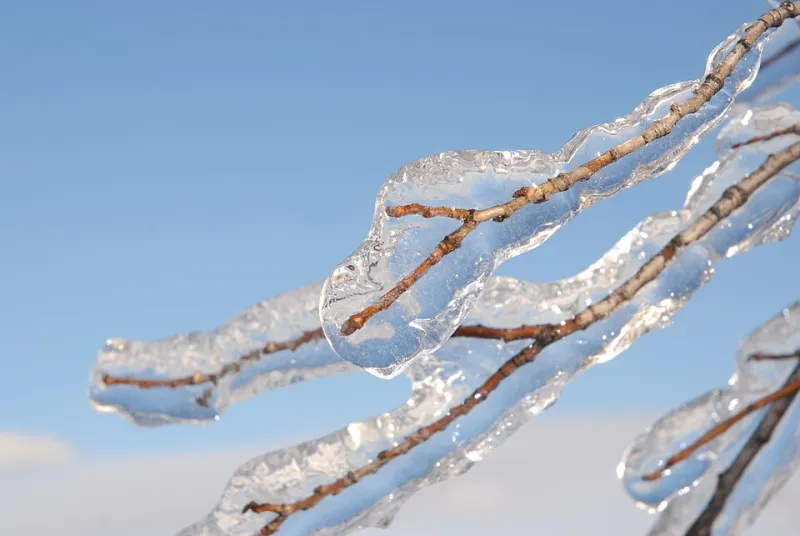
Photo: Velatrix, CC0, via Wikimedia Commons
You notice it first on the windshield: rain is falling, but the tires aren't throwing up spray. The wipers drag a little. The temperature readout says 33. Nothing looks white. Nothing looks wet in the usual way. And that is exactly the problem.
Freezing rain is the quietest road hazard in winter weather. It doesn't pile up like snow or bounce like sleet. It arrives as liquid, spreads across a cold surface, and turns transparent. The road keeps looking like a road until the moment it stops behaving like one.
The setup: a warm layer stacked over a cold surface
Freezing rain needs a specific atmospheric sandwich. Snow starts high, falls into a layer of air warm enough to melt it completely, and then keeps falling as liquid into a shallow pocket of subfreezing air near the ground. Those droplets become supercooled — still liquid, but ready to freeze the instant they touch something cold. A bridge deck, a stop sign, a windshield, a shoe sole. Contact does the work.
Sleet takes a different route. It refreezes into ice pellets before it lands, so it bounces and ticks against the glass. Freezing rain doesn't bounce. It coats. That distinction matters because sleet announces itself while freezing rain blends in. The National Weather Service draws the same line: freezing rain is liquid that freezes on contact, and it is the ingredient behind glaze, black ice, and the sort of morning commute that goes from normal to nonsense in a few miles.
Why the bridge turns first
Elevated surfaces lose heat from the top and the bottom. A bridge deck has cold air moving underneath it, while the roadbed on solid ground holds a little more warmth from the earth. That is why the old sign — bridge ices before road — is not folklore. It is physics with a warning label.
Ramps, overpasses, parking decks, sidewalks, and stairways follow the same logic. So do shaded stretches under tree canopy, north-facing slopes, and untreated lots where the plow never goes. On a freezing-rain morning, the main highway can feel merely wet while the ramp you need to take is already glazed. The trap is not always the road you are watching. It is the transition you are about to make.
The accretion clock
Ice accumulation is usually measured in fractions of an inch, and the numbers sound small until you translate them into driving. A trace — roughly a hundredth of an inch — can make a bridge deck slick. A tenth of an inch is enough to coat railings, branches, and windshields. A quarter inch is significant ice, the kind that starts bringing down small limbs and closing ramps. Half an inch or more is a crippling storm for travel and power.
But the driver's threshold is lower than the warning threshold. You do not need a quarter inch of ice to lose grip on a bridge. You need the first thin film, the one that fills the texture of the pavement and leaves no visual cue. If rain is falling and the surface temperature is at or below freezing, assume the accretion clock has started. Salt and brine can buy time, but rain dilutes treatment, and salt loses effectiveness as temperatures drop through the 20s. A pre-treated road is not a promise. It is a head start.
Real-time clues you can actually use
Start with the air temperature, but don't stop there. Your car's thermometer is a useful hint, not a precision instrument; it can read a degree or two off and it sits near a warm engine. Check the dew point, too. When the air temperature and dew point are close together and both are near freezing, the atmosphere is primed. Wet-bulb temperature — the reading you get when moisture evaporates and cools the air — can reveal a surface risk that the plain air temperature hides.
Then look for behavior. Are raindrops beading and freezing on the side mirror? Is the antenna glazed? Does the wiper smear instead of clear? Are the steps at the gas station shiny when they should be wet? Those are free field observations. Some state DOTs publish road-surface temperatures and plow-cam images; road weather information systems are worth a glance before a winter trip. Radar showing rain over an area with subfreezing surface readings is a freezing-rain signature, not a rainstorm.
The stay-put decision
If a freezing-rain advisory or winter weather advisory is active, the smartest move is often to delay. Not because the forecast is always right, but because the cost of being wrong is asymmetric. A missed appointment is an inconvenience. A glazed bridge at speed is a different category of problem.
If you are already out when the rain starts and the temperature is hovering at or below freezing, treat every bridge, ramp, and overpass as suspect. Cut speed before you reach them, not on them. Skip cruise control. Make every input — steering, braking, accelerating — slow and smooth. Increase following distance well beyond the usual winter cushion. If you feel the tires go light, ease off the accelerator and keep the steering steady; sudden braking on ice is how a slide becomes a spin.
And if the roads are clearly glazed, get off them safely and stay put. A parking lot, a truck stop, a diner — any safe exit beats pressing on through a transparent rink.
The thaw trap
Freezing rain often ends with a temperature rise that feels like permission. It isn't always. Shaded roads, bridge decks, and overpasses can stay icy long after the main pavement has gone wet. Overnight, whatever melted can refreeze into a fresh black-ice sheet. A salt truck may have passed your route; that does not mean it reached the ramp you need.
Freezing rain is a hazard that hides in plain sight. The forecast tells you it is possible, the thermometer tells you it is close, and the surface tells you the truth. When those three line up, the best driving decision is often the one that keeps you off the road entirely.