Don't Chase the Red Glow: Rewiring the Taillight Reflex in a Sudden Whiteout
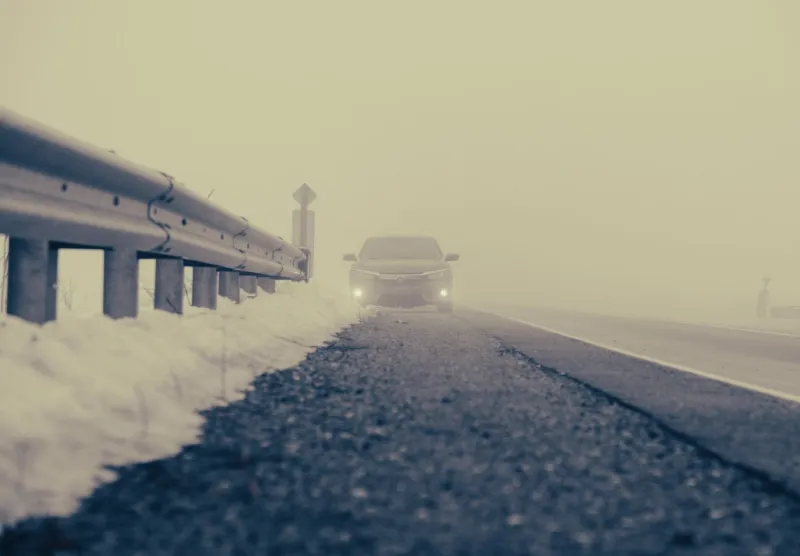
There's a moment on I-80 west of Laramie, and on I-90 outside Rapid City, and on the flat county roads of northern Iowa, when the world goes gray and the only thing left with edges is the pair of taillights ahead of you. Most drivers do the same thing in that moment: they tighten up. They close the gap. They follow those lights like a rope in the dark.
It feels like caution. It is closer to the opposite.
The Reflex That Feels Like a Plan
Following the car in front through a whiteout is a bet with a strange structure. You're wagering your reaction time on a stranger's judgment, their tires, their attention span, and the assumption that they can see anything you can't. If they brake for a plow, you brake late. If they miss a curve, you've just been given a guided tour of the ditch. If they hit something solid and stop dead, you arrive at the same spot with no time to do anything about it.
The instinct isn't stupid, either. Human beings track motion. In a world stripped of visual reference—no horizon, no shoulder line, no fence posts—a moving object becomes the only anchor available, and the brain grabs it hard. Researchers who study driver attention call the extreme version of this target fixation; the more ordinary version is just a car full of people subconsciously deciding that the guy in the Silverado is now the navigator.
What the Crash Reports Keep Saying
Winter storm crash counts are dominated by two patterns: rear-end collisions and single-vehicle run-offs. Both trace back to the same handful of decisions, and the taillight chase sits at the center of them.
Consider what a run-off looks like. A driver in low visibility fixes on the vehicle ahead. That vehicle drifts slightly right—maybe it's a wide shoulder, maybe the plow driver is hugging the fog line, maybe there's a slight bend. The follower, whose eyes are glued to the taillights and not the pavement, drifts right too. Six inches of drift becomes a wheel off the shoulder. The shoulder in a whiteout is not pavement. It's snow, or ice, or a soft rutted edge that grabs a tire and steers the whole car.
And rear-end crashes rarely happen at high speed in a whiteout. They happen at 35 mph with a 15-foot gap, because the follower was riding the lights for reassurance and never left a cushion wide enough for a surprise.
Why the Gap Shrinks Without Anyone Deciding To
Here's the sneaky part: nobody chooses to tailgate in a blizzard. Speed drops, and the gap shrinks along with it, because drivers judge following distance by eye rather than by seconds. At 60 mph on dry pavement, three car lengths looks obviously too close. At 30 mph in a grayout, three car lengths looks perfectly reasonable—right up until the lead car stops in half that distance and physics sends its invoice.
Snow also steals your braking. Stopping distances on packed snow commonly run several times longer than on dry asphalt, and on ice the number gets ugly fast. The cushion that felt generous at 45 mph on a clear day is a rounding error in a whiteout.
Lift, Look, Slow: The Five-Second Reset
When the horizon vanishes, run this drill instead of reaching for the lights ahead. It takes about five seconds and you can practice the motions on any dry highway this week.
Lift. Ease off the throttle before you decide anything. Not braking—lifting. Lifting is the one evasive move that can't cause a skid, and it buys you a half second to think.
Look. Take your eyes off the taillights and find the right-side fog line, the shoulder rumble strip, or the reflector posts. If you truly can't find any of those, you have already lost the information you need to keep moving safely. That's your signal to get off the road.
Slow. Reduce speed until your stopping distance fits inside what you can actually see. In practice that means crawling. Twenty-five miles an hour in a real whiteout is not timid—it's arithmetic.
Then set your own reference: fog line, posts, mirrors, repeat. You are driving the road, not the car in front of it. If the lead vehicle disappears into the gray, that's information, not abandonment—it means conditions just got worse and your number should get smaller.
The Decision You Should Make Before You Leave the Driveway
Every whiteout exit decision is made twice: once at the kitchen table with a forecast in front of you, and once on the shoulder with your heart rate at 140. The first decision is the one that counts.
Check the state road conditions app and the 511 line before you go—WYDOT, CDOT, Iowa DOT, and most other state agencies post closures and no-travel advisories in near real time. Look at the wind forecast, not just the snow total; a two-inch dusting with 40 mph gusts over open ground produces a ground blizzard that a six-inch calm snowfall never will.
Ask the blunt question: if visibility collapses, is there anywhere safe to stop between here and there? If the answer is no—long open stretches, no exits, no towns—then the honest plan is not to drive that segment.
Once you're out there, apply a simple rule. Wait out the worst of it at a truck stop, a gas station, or a rest area rather than pressing through. And if you do get caught in a sudden grayout with no exit in sight, slow to a crawl, get as far onto the shoulder as you safely can, and turn on your hazards. Many state DOTs and the National Weather Service advise staying buckled in and staying with the vehicle rather than walking out into traffic you can't see coming.
When You Realize You're the Lead Car
Sooner or later the red glow ahead vanishes into the gray, and you're the one out front. Someone behind you may now be using your taillights as their plan.
Give them something honest to follow. Steady, slow speed. Full headlights and hazards when you're crawling. Signal early. And if you decide to pull off and wait, do it deliberately, get well off the travel lane, and stay put—because a car stopped half in the lane in a whiteout is not a resting place. It's an obstacle with no warning.
The road will come back. It always does. The only question is whether you're still on it when it does.