Which Whiteout Are You In? Three Vanishing Horizons and How to Answer Each
Whiteout gets used like a catch-all for any time the weather turns the world into a gray card. That is understandable. From the driver's seat, the ski lift, or a ridge trail, the feeling is the same: the view quits, depth perception gets weird, and your brain starts asking bad questions. But the atmosphere is doing different jobs in each case. Wind-driven snow is a particle problem. Freezing fog is a droplet problem. Flat-light glare is a contrast problem. If you can name which one you are in, you can choose a smarter way out.
The horizon is only one part of the picture
Visibility is not just how far you can see. It is also whether your eyes can find edges, shadows, and texture. A snowstorm can leave you with half a mile of visibility and still erase the ditch, the centerline, and the shape of the next hill. That is why the first field question is not how bad is it? It is what is doing the erasing?
Maker one: wind-driven snow
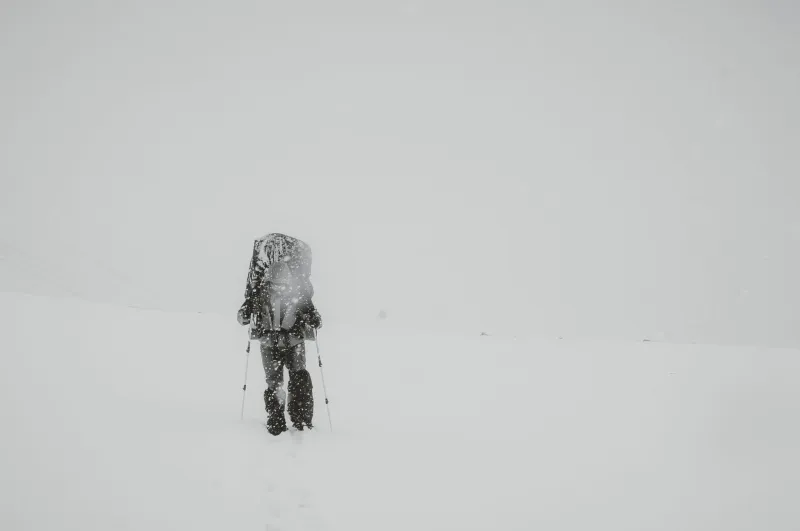
This is the classic ground-blizzard look. Snow on the ground gets picked up and pushed, or fresh snow falls while wind shoves it sideways. The result is a moving veil that thickens and thins in pulses. On the road, you may see snow snakes crossing the pavement, taillights smearing into red smudges, and roadside poles vanishing one by one. On open ground, the white surface and white air can merge into a single moving wall.
The science is mostly mechanical. Wind lifts loose crystals, carries them in short hops, and then suspends the finer stuff. Visibility can drop fast because you are looking through both falling snow and recirculated snow. Gusts make it worse. A Wyoming stretch of Interstate 80 can go from merely ugly to genuinely blind in the time it takes to pass a couple of exit signs. The same thing happens on open prairie, mountain passes, and lake-effect corridors.
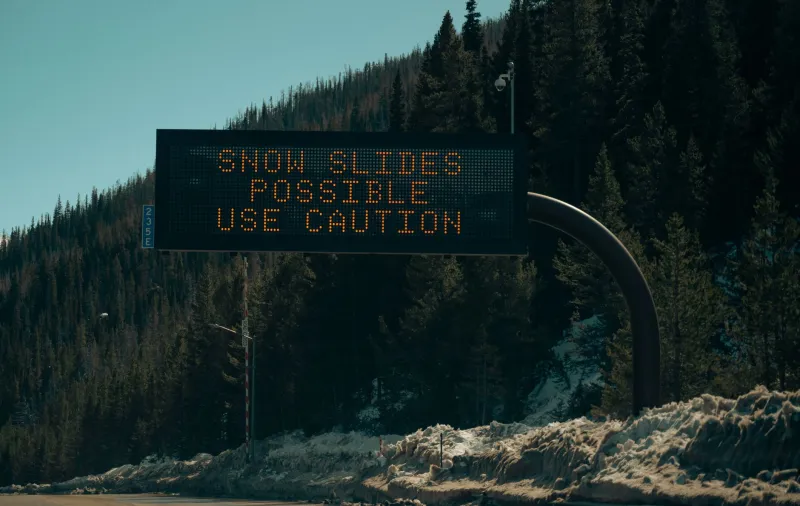
For drivers, the exit is usually patience plus position. Slow down early, use low beams, and turn off cruise control. Do not stop in a travel lane. If you must stop, take an exit or pull as far onto the shoulder as you can, keep your hazard lights on, and stay in the vehicle. Walking into traffic during a whiteout is a terrible trade. For hikers and skiers, wind-driven snow is a navigation problem. Pull out the compass or GPS before your hands are cold and your landmarks are gone. Follow a pre-set bearing or a flagged route. If the wind is loading slopes, add avalanche terrain to the list of things you are avoiding.
Maker two: freezing fog
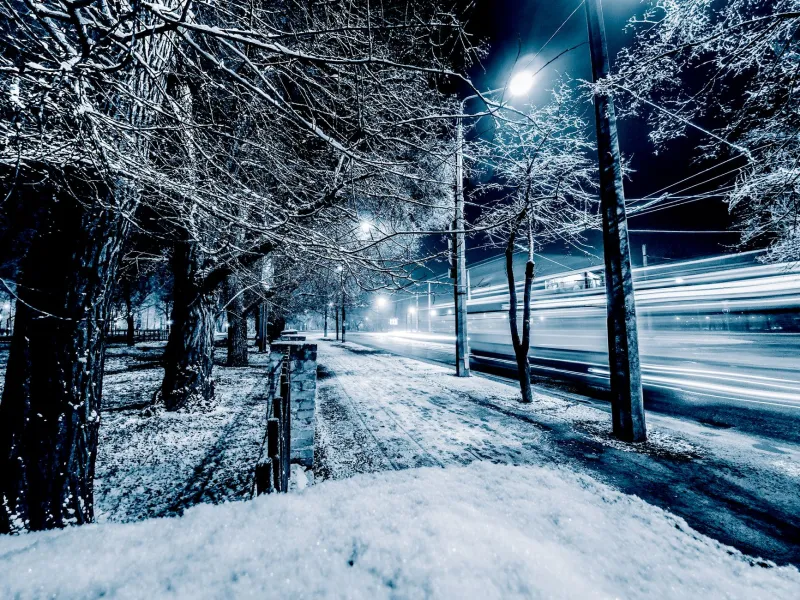
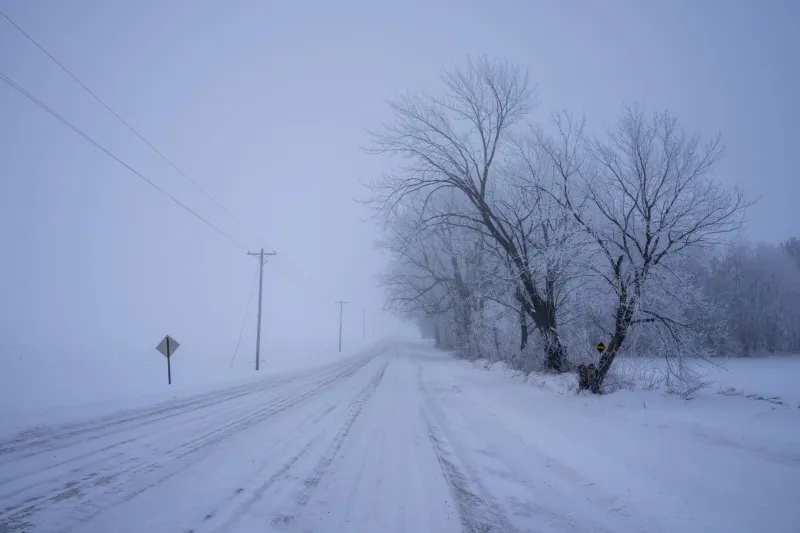
Freezing fog looks quieter. It often arrives as a gray-white wall with little or no wind, and that calmness is the trap. The fog is made of supercooled droplets that stay liquid below freezing until they touch something. Then they freeze. Trees get rime ice, antennas grow white spikes, and roads turn into skating rinks, especially bridges, overpasses, and shaded curves.
Cues: glazed branches, ice feathers on signs, a flat gray sky that sits on the ground, and no blowing snow. Visibility may be a quarter mile or less. Your windshield wipers may collect ice. Your boots may squeak. The road may look wet but behave like ice.
Drivers should treat freezing fog as an ice warning first and a visibility warning second. Use low beams or fog lights, not high beams. High beams bounce off the droplets and make the wall brighter. Increase following distance, brake early, and avoid sudden steering. If the fog is dense and the road is glazing, the best exit may be a safe pull-off and a wait for sanding crews. For hikers, freezing fog means traction and navigation. Microspikes or crampons may be needed. Rime ice on a ridge can make easy ground dangerous. Turn around if the route depends on seeing cairns or rock features.
Maker three: flat-light glare
Flat light is the odd one. You may have decent horizontal visibility and still lose the ground. An overcast sky throws diffuse light across snow, so shadows disappear. The snow surface and the sky can have nearly the same brightness. Terrain features, dips, rollers, cornices, and the edge of a ski run, vanish. The horizon may not be a line at all.
This is a contrast problem, not a particle problem. Skiers know it as flat light. Drivers see it on snow-covered fields and open plains when the road edge is marked only by poles. Hikers see it above tree line when the snowfield ahead looks like one continuous sheet. The danger is misjudging slope angle and distance. You can step off a small cornice or drive toward a ditch because the visual cue was never there.
For drivers, reduce speed and aim for fixed references: delineator posts, tire tracks, guardrails, and the seam between plow passes. Do not trust the apparent flatness of the road. For skiers, stay on marked runs, ski with a buddy, and avoid cliffs or tree wells when the light is flat. For hikers, use a GPS track and keep your route on gentle terrain. If the ground has no shape, believe your instruments and your map more than your eyes.
Three exits, not one
The three whiteout makers do not share a single response. Wind-driven snow often says get out of the wind and off the road. Freezing fog says get off the ice or wait for treatment. Flat light says slow down and follow fixed references. But there are three general exits worth preloading in your head.
First, stop and shelter. This is the right call when visibility is gone and movement adds risk. In a vehicle, that means a safe pull-off, hazards on, seatbelt off only if needed, and patience. On foot, it means an emergency shelter, extra layers, and a fixed waiting spot.
Second, navigate by instrument. This is for when you can still move but cannot trust your eyes. Use a compass bearing, a GPS track, or a flagged line. Do not wander toward a vague dark shape. Dark shapes in whiteouts are often closer or farther than they appear.
Third, reverse to a handrail. A handrail is any reliable feature that leads you back: a road, a fence line, a creek, a ski-run boundary, a plowed shoulder. If you can retreat along it, do that before the whiteout thickens. Pride is not a navigation aid.
Before you leave the house, check the forecast for the mechanism, not just the snow total. A windy snow event, a freezing-fog advisory, and a flat-light day on the mountain are different animals. Pack for the one you are likely to meet. And if the horizon disappears, name what is happening. The name will help you pick the exit.